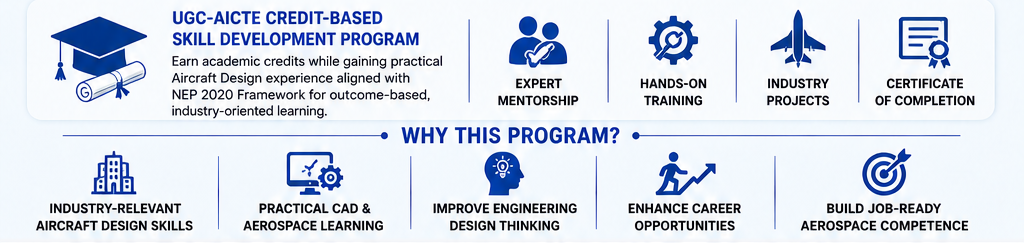
Learn Industry-Oriented Aircraft Design Skills with Hands-on Training in CAD, Aerodynamics, Aircraft Performance Analysis, and Real-World Aerospace Projects.
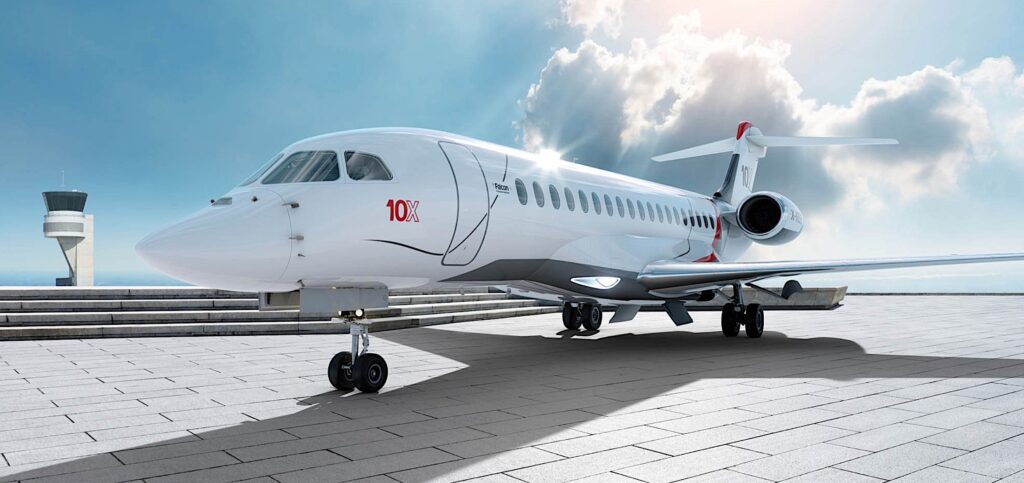
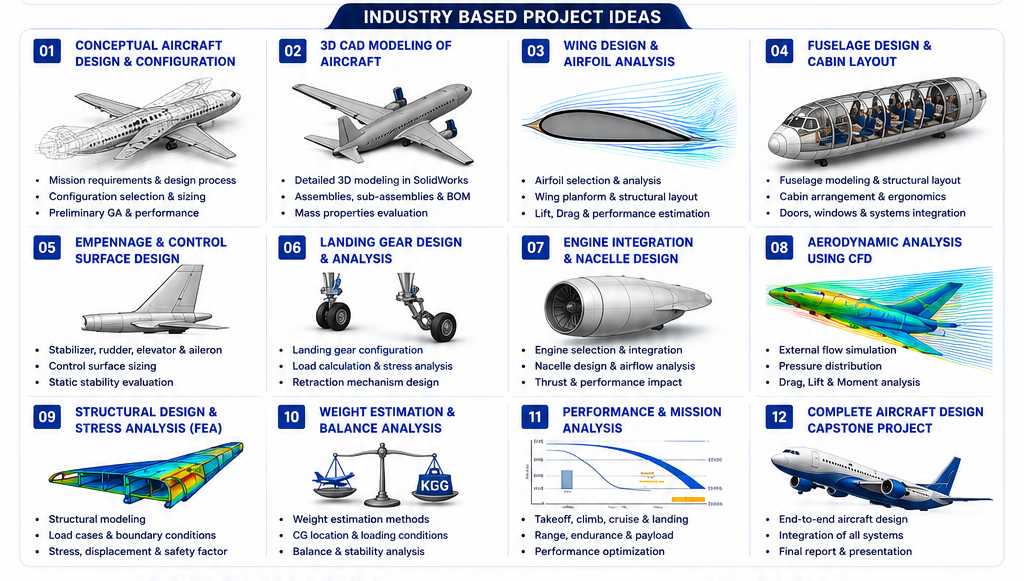
Gain industry-oriented Aircraft Design skills through hands-on training and real-world aerospace engineering projects. This internship is designed to help students apply aircraft design principles to practical challenges in Aerospace and Aviation industries. Learn aircraft conceptual design, aerodynamics, airfoil and wing design, aircraft performance analysis, stability and control, structures, propulsion systems, and CAD modeling while building a strong foundation for a successful career in aerospace engineering

Acquire practical Aircraft Design skills through hands-on training, real-world aerospace projects, and industry-oriented learning. Explore every stage of the aircraft design process—from conceptual design and airfoil development to structural fundamentals, propulsion systems, and performance analysis—while preparing for rewarding careers in the aerospace and aviation sectors
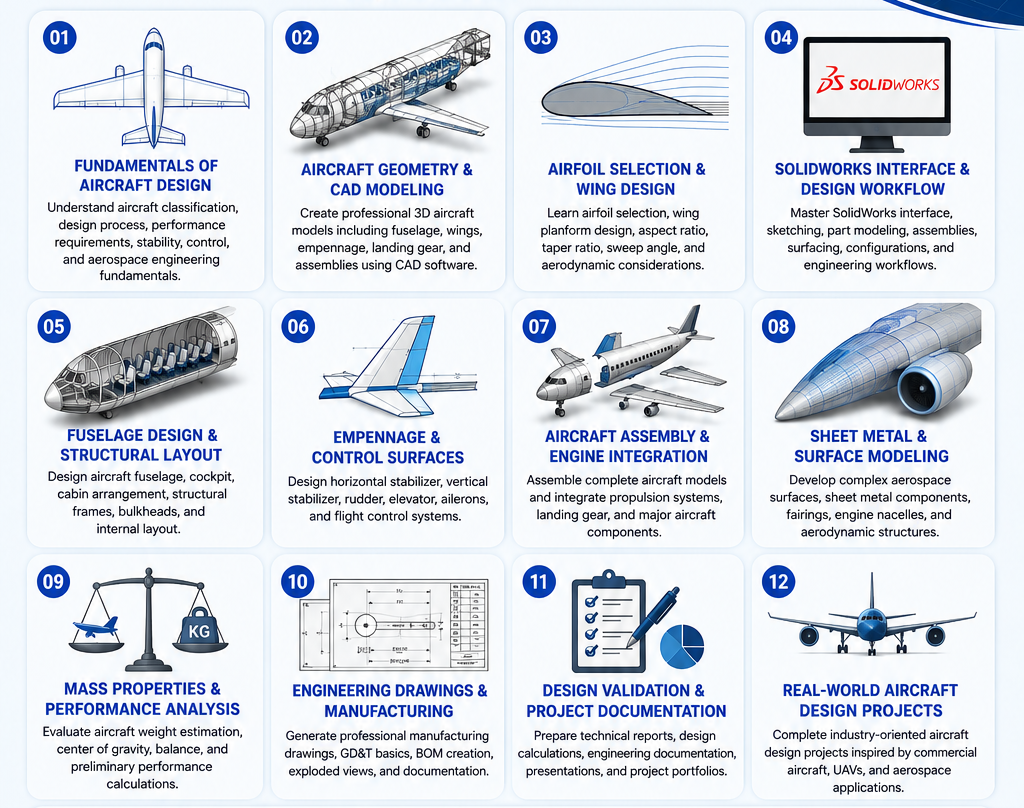
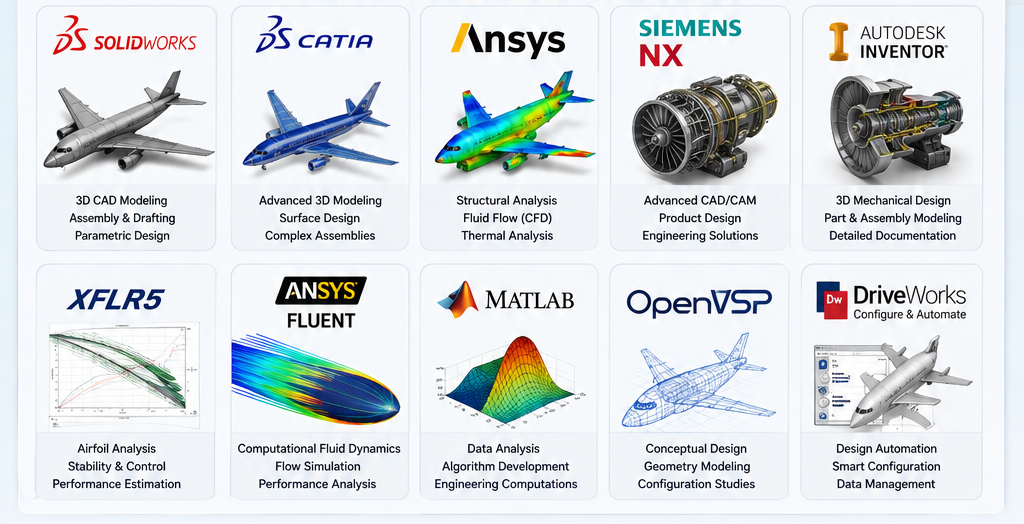
Expert mentorship and guided learning, you will understand the complete aircraft design workflow from concept to analysis. This program helps you develop problem-solving abilities and industry-ready engineering skills required in aerospace careers.
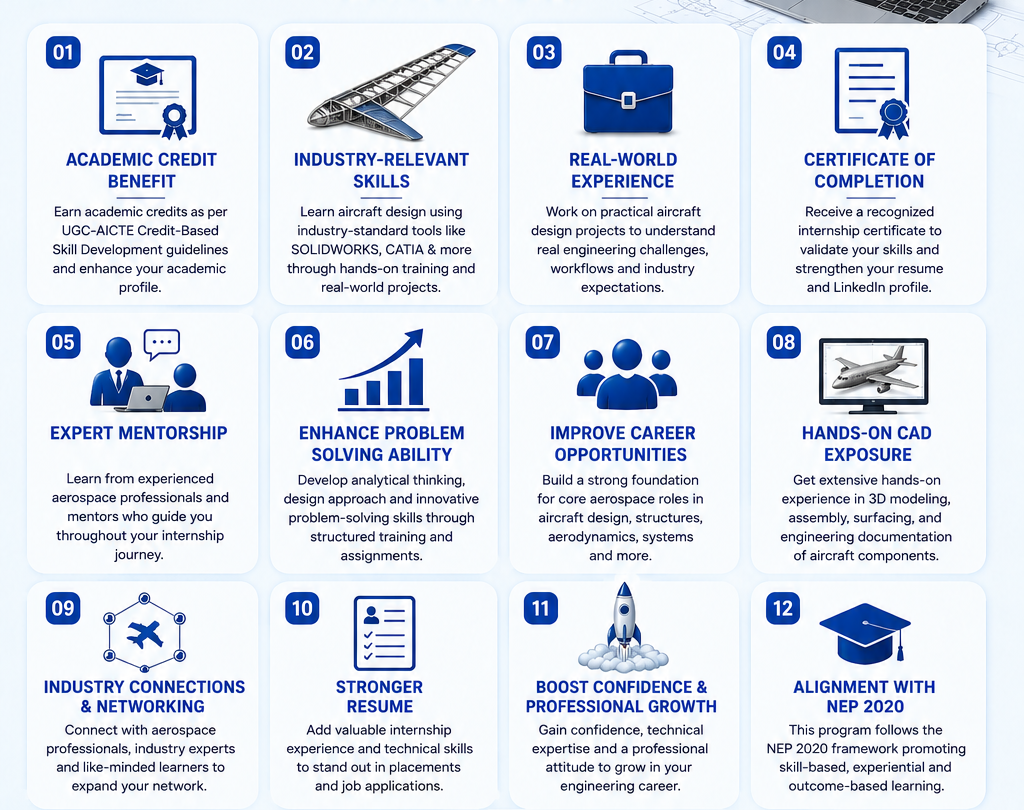
Register open to Diploma, B.E./B.Tech, M.E./M.Tech, B.Sc., M.Sc., undergraduate, postgraduate students, recent graduates, research scholars, and working professionals who are interested in Aircraft Design(ADI) and engineering simulation. Students from Aerospace, Mechanical, Automobile, Energy, Production, Manufacturing, Civil, Marine, Mechatronics, Robotics, and other related






Historical overview of aviation and its evolution.
Parts of aircraft and its functions contribute to the organization’s aerospace infrastructure.
Types and classifications of aircraft.Aviation Technology
The design process and its phases.
Principles of aerodynamics and airflow around an aircraft.
Lift, drag, aerodynamic moment, and thrust considerations.
Airfoil terminology, types of airfoils, NACA airfoil series, types of drag Relation between AOA and lift coefficient, the relation between AOA and drag coefficient, the relation between AOA and moment coefficient
types of shock waves, thrust required, thrust available, power required, power available
Aircraft performance, stability, and control
Designing aircraft structures for strength and safety.
Composite materials and their applications in aircraft.
Stress analysis and structural integrity
Types of aircraft engines and their working principles.
Propeller and jet engine design.
Engine performance and efficiency.
Introduction to CATIA V5 Interface
Overview of CATIA V5 software and its applications
Understanding the user interface: workbenches, toolbars, and navigation
Setting up preferences and customization options
Introduction to sketching tools and constraints
Creating 2D sketches and profiles
Extrusions, revolutions, and sweeps
Advanced sketch-based modeling techniques
Creating complex parts using multi-feature design
Applying materials and properties to parts
NACA Airfoil wing.fuselage tail propeller turbofan engine.turbojet engine
Introduction to CATIA V5 Surface Design
Overview of CATIA V5 interface focusing on the Surface Design workbench
Introduction to surface-based modeling concepts
Understanding the difference between solid and surface modeling
Sketching for Surface Design
Review of basic sketching tools in CATIA V5
Sketching techniques relevant to surface modeling
Constraints and dimensions for precise sketching
Best practices for sketching profiles for surfacing
Creating Basic Surfaces
Introduction to surface creation tools in CATIA V5
Creating planar, cylindrical, and conical surfaces
Techniques for manipulating and modifying basic surfaces
Understanding surface continuity and curvature analysis
Advanced Surface Creation
Lofting techniques for creating complex surfaces
Sweep and blend features for generating intricate surface geometry
Using guide curves to control surface shape
Surface filleting and blending for smooth transitions
: Aircraft Fuselage Design
Design considerations for aircraft fuselage surfaces
Techniques for sketching and creating fuselage surfaces
Lofting and blending methods for fuselage sections
Refining and optimizing fuselage design using surface tools
Wing and Tail Surface Design
Aerodynamic considerations for wing and tail surfaces
Sketching and creating wing profiles using surface tools
Lofting and blending techniques for wing surfaces
Designing tail surfaces and integrating them with the fuselage
: Landing Gear and Other Components
Creating landing gear surfaces using surface tools
Incorporating landing gear components into the aircraft model
Designing other aircraft components such as engine nacelles, fairings, etc., using surface techniques
Ensuring compatibility and integration of various components
: Detailing and Refinement
Adding details such as windows, doors, and panel lines using surface modeling
Refining surface geometry for aesthetic appeal and aerodynamic performance
Surface analysis tools for evaluating curvature and continuity
Iterative refinement process for achieving desired surface quality
: Assembly and Integration
Assembling the individual surface components into a complete aircraft model
Techniques for managing assembly relationships and constraints
Verifying fit and alignment of components through assembly checks
Integration of surface-based components with other systems
Historical overview of aviation and its evolution.
Parts of aircraft and its functions contribute to the organization’s aerospace infrastructure.
Types and classifications of aircraft.Aviation Technology
The design process and its phases.
Principles of aerodynamics and airflow around an aircraft.
Lift, drag, aerodynamic moment, and thrust considerations.
Airfoil terminology, types of airfoils, NACA airfoil series, types of drag Relation between AOA and lift coefficient, the relation between AOA and drag coefficient, the relation between AOA and moment coefficient
types of shock waves, thrust required, thrust available, power required, power available
Aircraft performance, stability, and control
Designing aircraft structures for strength and safety.
Composite materials and their applications in aircraft.
Stress analysis and structural integrity
Types of aircraft engines and their working principles.
Propeller and jet engine design.
Engine performance and efficiency.
Integrating aircraft systems, including avionics, navigation, and communication.
Flight control systems and automation.
Safety and redundancy considerations.
Overview of aviation regulations and safety standards.
Certification processes for aircraft and components.
The role of organizations like the FAA.
The design lifecycle from concept to prototype.
Design reviews, trade-offs, and decision-making.
Prototyping and testing.
Introduction to CATIA V5 Interface
Overview of CATIA V5 software and its applications
Understanding the user interface: workbenches, toolbars, and navigation
Setting up preferences and customization options
Introduction to sketching tools and constraints
Creating 2D sketches and profiles
Extrusions, revolutions, and sweeps
Advanced sketch-based modeling techniques
Creating complex parts using multi-feature design
Applying materials and properties to parts
NACA Airfoil wing.fuselage tail propeller turbofan engine.turbojet engine
Creating assemblies of parts
Inserting components and defining constraints
Exploded views, motion simulation, and clash detection
Introduction to CATIA V5 Surface Design
Overview of CATIA V5 interface focusing on the Surface Design workbench
Introduction to surface-based modeling concepts
Understanding the difference between solid and surface modeling
Sketching for Surface Design
Review of basic sketching tools in CATIA V5
Sketching techniques relevant to surface modeling
Constraints and dimensions for precise sketching
Best practices for sketching profiles for surfacing
Creating Basic Surfaces
Introduction to surface creation tools in CATIA V5
Creating planar, cylindrical, and conical surfaces
Techniques for manipulating and modifying basic surfaces
Understanding surface continuity and curvature analysis
Advanced Surface Creation
Lofting techniques for creating complex surfaces
Sweep and blend features for generating intricate surface geometry
Using guide curves to control surface shape
Surface filleting and blending for smooth transitions
: Aircraft Fuselage Design
Design considerations for aircraft fuselage surfaces
Techniques for sketching and creating fuselage surfaces
Lofting and blending methods for fuselage sections
Refining and optimizing fuselage design using surface tools
Wing and Tail Surface Design
Aerodynamic considerations for wing and tail surfaces
Sketching and creating wing profiles using surface tools
Lofting and blending techniques for wing surfaces
Designing tail surfaces and integrating them with the fuselage
: Landing Gear and Other Components
Creating landing gear surfaces using surface tools
Incorporating landing gear components into the aircraft model
Designing other aircraft components such as engine nacelles, fairings, etc., using surface techniques
Ensuring compatibility and integration of various components
: Detailing and Refinement
Adding details such as windows, doors, and panel lines using surface modeling
Refining surface geometry for aesthetic appeal and aerodynamic performance
Surface analysis tools for evaluating curvature and continuity
Iterative refinement process for achieving desired surface quality
: Assembly and Integration
Assembling the individual surface components into a complete aircraft model
Techniques for managing assembly relationships and constraints
Verifying fit and alignment of components through assembly checks
Integration of surface-based components with other systems
Wireframe Design
Aircraft Fuselage Design
Wing Design
Tail Design
Landing Gear Design
Need to submit
Yes
Yes
Yes
Need to Submit
Performance Based
Welcome to MARS Exploration, the top aerospace startup in India, offering a cutting-edge online internship program for engineering students.
Important Links
Aircraft Design Internship
Rocket Design Internship
CFD Internship
Design & Analysis Internship
Finite Element Analysis Internship
Contact
hrmarsexplorationpvt@gmail.com
+91 8530636474 (Whatsapp)
A/p MadguleTal -Atpadi
Dist Sangli Maharashtra
© 2024Created by MARSE IT Department